A small studio making one big game, and a smaller one beside it.
We're building Valdris — a VR action-MMORPG for Meta Quest 3 where a city grows through what players do — and Bestiarium, a small naturalist's field-book for iOS, Android, and Steam.
We build out loud, fortnightly. This is where we write down what we made, what we broke, and what comes next.
One pair of hands directs. The code is written by AI.
Studio Vellum is small — one person directing, with an uncommon collaborator. Every game here is ours to imagine, design, and decide, and every line of its code is written by AI, working to those plans. It is a strange, quiet way to build, and it is working: two games are standing because of it.
What code can't do is draw, sculpt, or sing.
We lean on free assets from the Unity Asset Store, and they carry us a long way. But if you would enjoy lending real craft to a small, honest project, there is a bench here for you. No salary yet — this is a passion project, built out loud — but the work is real and the credit is yours.
Graphics & 2D Art
UI, illustration, the hand-drawn look
3D Modeling
Props, characters, the world of Valdris
Sound & Music
Ambience, score, the feel of a place
Have a craft to lend — or simply an idea for a game? Every idea is welcome here.
Dispatch · Blender & Unity9 July 2026Reading time · 5 min
DISPATCH · 9 JULY · A RUNE FOR EVERY PEOPLE
From Blender to prefab, without an artist in between.
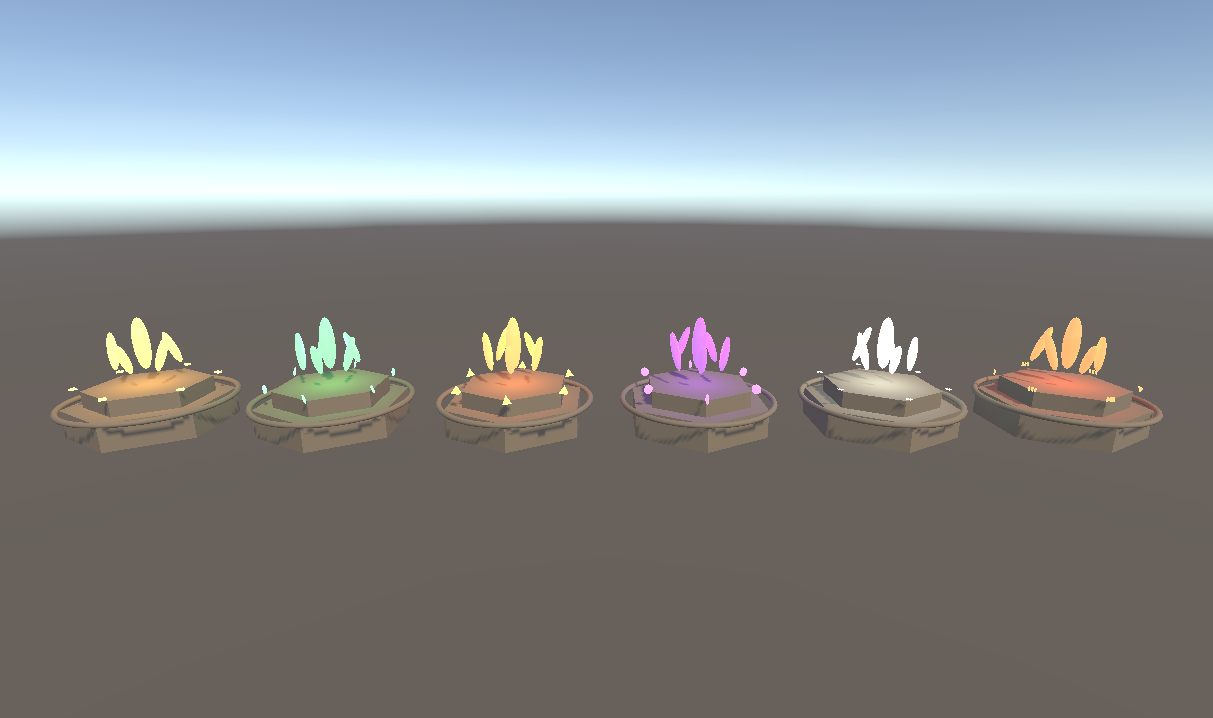
A pipeline, not a fix: Blender and Unity now take instructions from the same place, so a placeholder can be a placeholder with character instead of a grey capsule. First test of the wiring, six EssenceNodes came out the other end — one per people, each with its own rune-shape and colour, straight from the lore we already had.
by the studio · 5 min read
Left to right: Humans, Sylvari, Dwergar, Umbra, Luminae, Feralis — six EssenceNodes, one lore-true rune each, four metres apart for the comparison shot
The 258 codex creatures we generated a few weeks back still spawn as grey primitives — silhouettes that tell a spider from a golem and nothing more. Nobody says "that looks great" about a grey capsule. This fortnight the question was whether Blender could be driven the same way Unity already is — by Claude, without a dedicated 3D artist standing between an idea and a mesh. It can. What comes out is still a placeholder, but now it's a placeholder we can iterate in minutes instead of asking someone to sculpt.
Two tools, one conversation 01 / 03
The setup was two MCP servers and one config file — simple in theory, a few hours of trial-and-error in practice.
→Blender 5's compositor moved the furniture.use_bloom is gone, Scene.node_tree is now Scene.compositing_node_group, and the default EEVEE Next engine doesn't give you bloom for free. Written down in a setup doc so the next session doesn't relearn it. Tools
→Two radios, different frequencies. Unity-MCP defaults to HTTP over a localhost socket; our Python side spoke stdio. No connection until Unity was told to speak stdio too, with a small file under ~/.unity-mcp/ sharing the port between the two. Tools
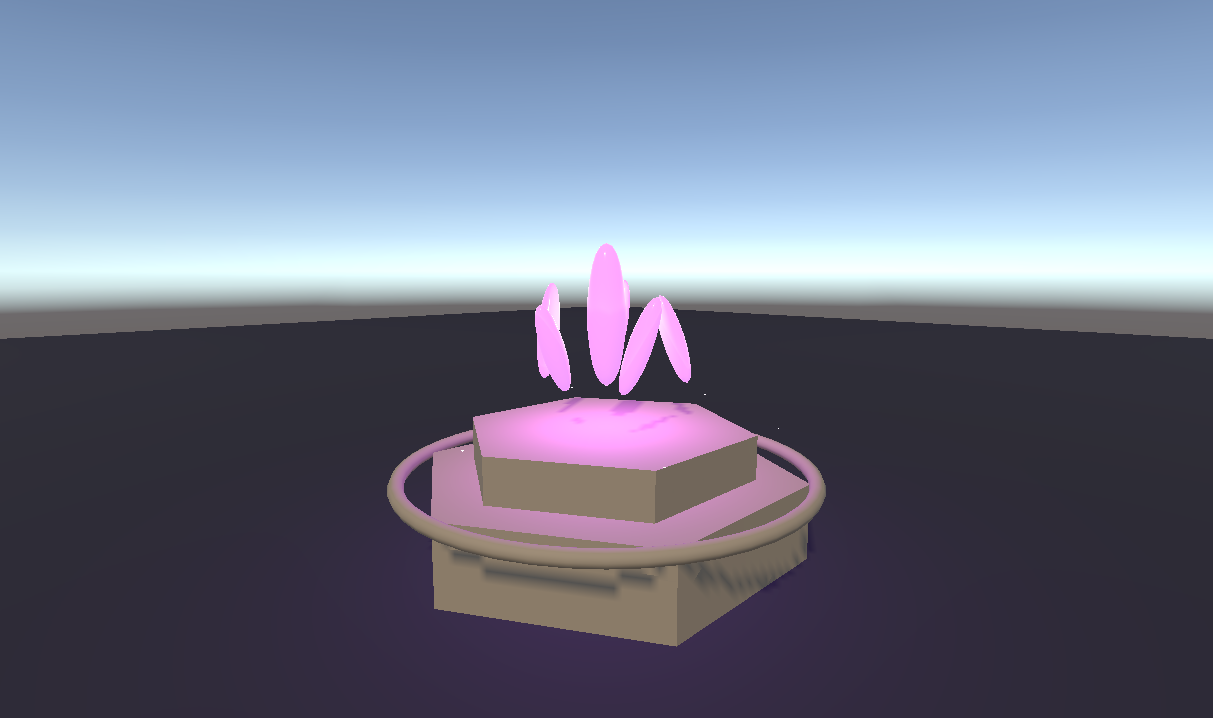
+A first model, to prove the wire works. A generic EssenceNode — hexagonal plinth, six glowing crystal shards, a torus rim, emissive tiles on top — modelled, exported as GLB, and read straight into Unity's asset database. Two rounds of tuning followed: the crystals bleached white until the emission strength came down from 25 to 3.5, and the rune-tiles were invisible until we noticed we'd placed them just inside the plinth's own radius. Art
The first EssenceNode out of the pipeline — proof the wire between Blender and Unity actually works, before any of the six peoples had their own version
Six peoples, six runes 02 / 03
The generic node had violet crystals because "crystals are purple" is a default, not a choice. Aetheria's six peoples already carry a symbol and a colour in the lore — that mapped straight onto the model.
+Sylvari — the Wilds. Emerald green, a leaf-drop rune. Content
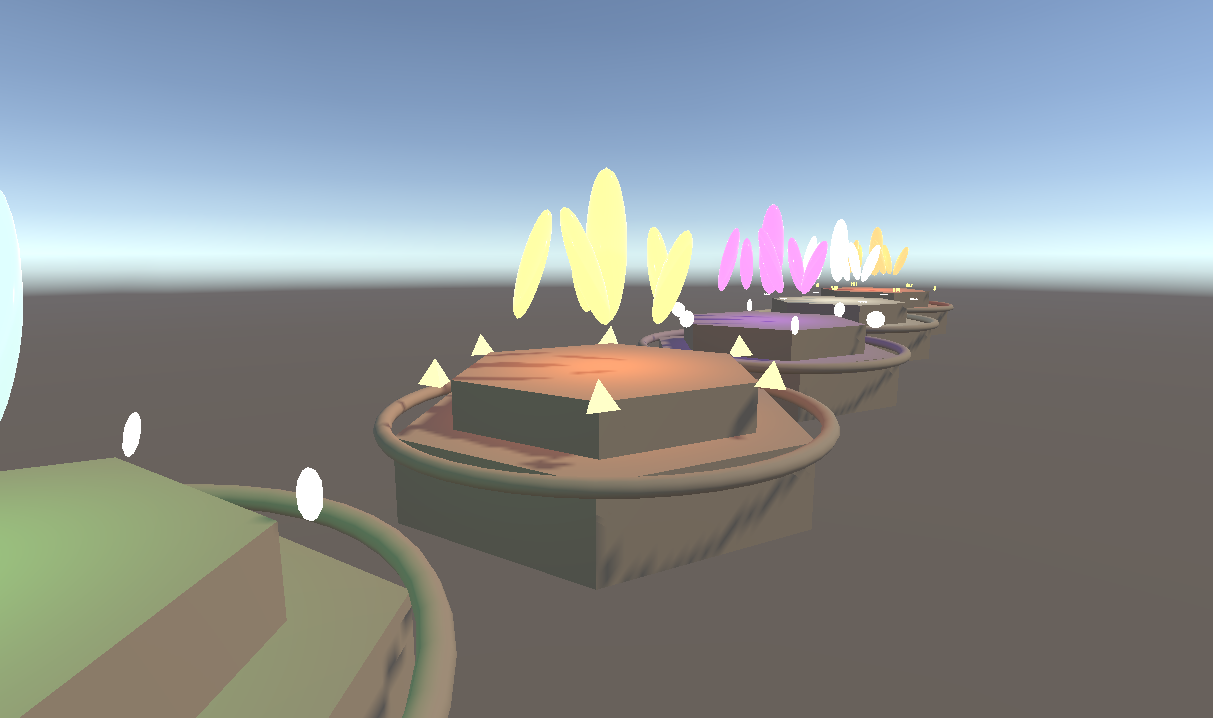
+Dwergar — the Deep. Copper-amber, a triangular mountain rune. Content
+Umbra — the Shadows. Deep violet, a crescent rune. Content
+Luminae — the Light. White-cyan, a star rune. Content
+Feralis — the Untamed. Rust orange, a three-toed claw rune. Content
One Blender script loops the six race configs, swaps the rune meshes, tints the materials to each people's signature colour, and exports six GLBs — thirty seconds of Blender's time for what would otherwise be six separate sculpting passes. Unity does the mirror pass in C#: load each GLB, generate per-race emissive materials, drop a point light inside every node so the plinth catches its own colour in bounce-light. Each now lives as its own prefab, ready to spawn on the six racial routes when city-visual-builder gets to it.
Close in on the Dwergar node — the triangular mountain runes around the rim, the same anvil-and-peak symbol Bram reaches for when he talks about the Deep's royal graves
What didn't land 03 / 03
Not every thread from this week paid off, and that's worth saying plainly rather than quietly dropping.
!Recipes blocked by missing base items. 33 of 35 Farmer crops and 77 of 83 Cook-database recipes can't generate yet — the seed items and finished-dish items they need (wheat_seed, and the like) simply aren't in the item database. The generators themselves work; the content layer under them is what's missing. Adding those base items is its own pass, not done here. Content · Known gap
!A regression, caught and rolled back. Forcing an overwrite flag to re-run the Farmer generator also overwrote the fourteen Cook recipes we'd hand-tuned by ingredient a week earlier, replacing them with the shorter database import. git checkout on that folder put it right. Fix
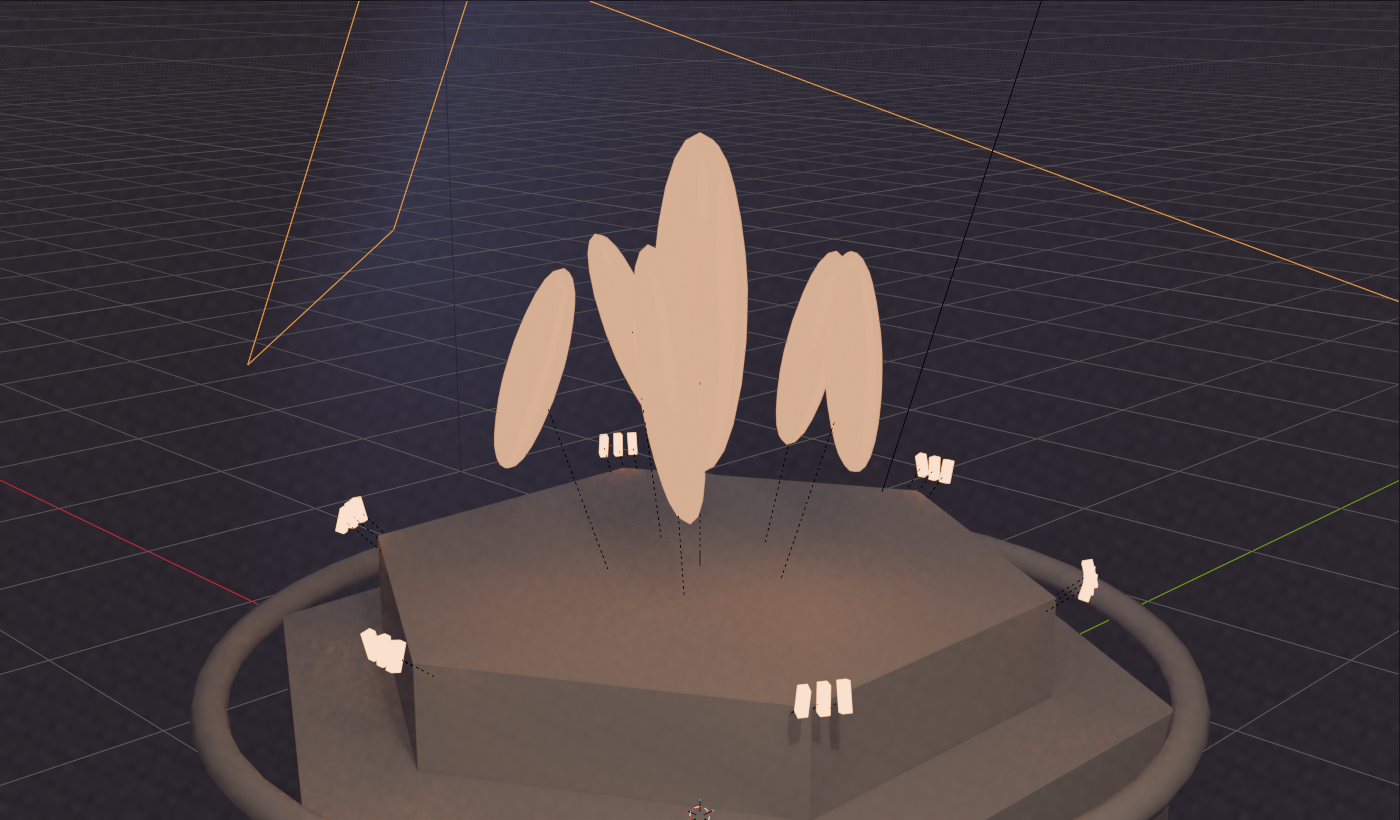
The whole build, seen from the Blender side — one EssenceNode object, fifteen mesh children, three materials, three lights, one camera. Nothing sourced from outside; every shard modelled in the same file
"Not one placeholder-primitive left standing where six characterful ones now stand. The Essence-Network becomes legible from a distance — you can see which people's route you're building just by the colour of the light."
— from this issue
The pipeline is the actual news here, more than the six nodes it produced. For the 258 codex creatures still spawning as grey capsules, this is now a tool in the kit rather than a wish: a silhouette pass in Blender, an export, and Unity picks it up. Next, whichever of that backlog is loudest — and finally giving the Farmer and Cook chains the base items their recipes have been waiting on.
Until then. Sword in hand. Six lights, six colours, one route each.
— Studio VellumGAMES
Heerhugowaard · 9 July 2026
Earlier letters
DISPATCH · 26 JUNE – 3 JULY · CHAPTER I CLOSESThe Essence-Network works end to end, and every trade can craft.▾
DISPATCH · 26 JUNE – 3 JULY · CHAPTER I CLOSES
The Essence-Network works end to end, and every trade can craft.
A week and a half that closed the whole Chapter I framework: the world grew to 7.5 kilometres with rivers, bridges and seven biomes; the Essence-Network runs from harvest to a Core that unlocks new city rings; a raid on a node is now a fight with real stakes; and — after three separate sessions chasing it — all eleven trades finally have real recipes with real ingredients.
by the studio · 7 min read
Aetheria · 7 biomes · 6 racial routes7500 m, sea to sea
Valdris · Wilds · Deep · Sand · Highreach · Aetheria · Untamed — one splatmap, no hard edges
Schematic · seven region-tints blended by one shared splatmap, feeding terrain, foliage and ambient fog and light alike
Ten days that behaved like one long session with a single throughline: the defense-events skeleton from the last letter turned out to have nothing at the end of it worth fighting, and pulling on that thread unravelled a chain — enemies without meshes, a VR player without a weapon, a cook without flour. Each fix opened the next. By the end, the Essence-Network runs from a monster on a node to a sword in your hand to supper on the table, and the 7,500-metre world it all happens in has rivers running through it.
A world with rivers in it 01 / 04
The 10×10 tile terrain from a few weeks ago grew up: 7.5 kilometres on a side, meeting the sea, with real biome character instead of one flat green.
+Sea, rivers, bridges, plateaus. A smoothstep falloff drowns the world's edges into open sea; three Catmull-Rom rivers meander between the racial routes and carve real beds into the terrain; every route crosses a river gets a placeholder bridge — deck, abutments, railings; and every totem and EssenceNode gets its own flat building pad, carved in the right order so nothing fights the terrain underneath it. World
+Seven biomes, one shared truth. A region catalogue gives Valdris and its six racial neighbours their own terrain tint, foliage tint, ambient tint and tree density, blended smoothly at the borders so nothing snaps between zones. Terrain, foliage scatter and the fog/light blender all read from the same region lookup, so a biome boundary means the same thing everywhere. World
+Luminae breaks its own rule, on purpose. Five peoples get a ground totem and a straight route. Luminae — the sky people — get a small ground portal and four floating islands climbing toward a sky-capital tower, a lore call made deliberately and written into the plan doc so it doesn't get "fixed" back to the standard pattern later. World · Lore
The Essence-Network, corrected and closed 02 / 04
What had been a purify-and-cleanse interaction turned out to be a simpler, better idea: essence is just a resource you harvest, like ore.
→A course correction. EssenceDeposit now follows the same pattern as a mineable vein — harvest into a canister, carry it out, spend it anywhere — rather than the three-hit "cleanse" mechanic it started as. Fix
+Nodes you build, routes you can see. Each of the six peoples gets a compass-spoke of buildable EssenceNodes running from Valdris toward their racial city; a flow-visual lights each segment solid once both its ends are built, and shows a faint "planned" line where they aren't yet. Costs rise per node — timber, then iron, then coal, copper, quartz, gold — verified in full before anything is spent. Systems
+The Core unlocks the city. Filling the Core now unlocks rings automatically — 25% opens agriculture, 50% industry, 75% the great-housing ring, 100% the harbour — with Ring 7's royal district deliberately held back for Chapter II. Progress and built-node state now survive a restart. Systems
+Raids with real stakes. A node has a small chance per minute of being attacked; now the attackers are visible (generated silhouettes per codex creature, tinted by their affix), the VR player is actually armed (a proper combat rig, not just inventory and movement), and the equipped weapon does its own damage instead of a hardcoded number. An active raid doesn't survive a restart on purpose — being punished for being offline isn't the kind of stakes we want. Systems · Fair play
Eleven trades, all craftable 03 / 04
Three of eleven professions were end-to-end playable a fortnight ago; the other eight had working benches and nothing to make at them. The fix wasn't the recipe logic — that was already generic and complete — it was that ingredients like flour, raw meat, cut gems and cloth bolts simply didn't exist yet.
+91 new base items, six languages each. Plain RPG staples — planks, dough, hides, parchment — sitting beside Valdris' own: an Aether-rune steeped in the Source, race-woven robes for Sylvari, Umbra and Luminae, Dwergar and Feralis catalysts, and the Valdris dumplings. Content
+~360 recipes, across all eleven trades. Farmer and Rancher feed Leatherworker and Tailor; Hunter's butchered cuts feed Cook; Enchanter turns crystal shards into scrolls and racial runes; Jeweler cuts and sets gems. Each generator cross-checks its output against the real item database instead of failing silently. Alchemist is the one trade still waiting on its own recipe pass. Content
Loose ends, tied off 04 / 04
+An admin backend with a real floor under it. A command bus, a session-token consumer dispatching fourteen admin actions, and a role store behind an interface — all working in-memory today, with the seams already cut for Redis and Postgres later. Nothing here waits on the external webapp existing first. Architecture
+Localization, fully caught up. All 391 items and all 151 quests now have names, descriptions and objectives in six languages, verified by script — zero missing keys. The lore book stays hand-translated on purpose; that's craft, not filler text. Localization
→Quest 3 stopped paying an HDR tax it didn't need. The Quest 2/Quest 3 graphics-quality split turned out to already exist; what was still wrong was HDR left on for Quest 3 (display is LDR anyway) and a stale default pipeline reference between scene-load and the tier manager taking over. Both fixed. Fix
Ten days ago Chapter I was a framework with gaps in it — a raid you couldn't fight, trades with nothing to craft, a world that stopped at 2.25 kilometres. None of that is true anymore. What's left is content and polish: Alchemist's recipes, real weapon meshes, the Awakening cinematic waiting for Chapter II, and a performance pass on Quest 2 before a real playtest on the weakest headset in the room.
Until then. Sword in hand. A network that reaches every people.
— Studio VellumGAMES
Heerhugowaard · 3 July 2026
DISPATCH · 18 – 22 JUNE · TWO GAMES, IN PARALLELA village learns to unlock itself, and a dungeon learns to breathe.▾
DISPATCH · 18 – 22 JUNE · TWO GAMES, IN PARALLEL
A village learns to unlock itself, and a dungeon learns to breathe.
A week split cleanly between the two games on the bench. Island Survival went from "the scripts won't even compile" to a walkable, procedural island with a gather loop and four craftable tools. Valdris got a housing rent-and-buy flow players can actually test, a demo city that arranges itself instead of overlapping, and a cave/dungeon generator that grew a soul: flickering torches, secret rooms, and a boss chamber worth finding.
by the studio · 6 min read
Dungeon / cave generator · one seed, one shape
low corridor · high room · lava chamber · pillar hall · boss room, altar & chest
Schematic · the generator's cell-graph — low, hobble-floored corridors between tall rooms, a boss chamber at the far end, a secret room somewhere it won't tell you
Two games, one bench. Island Survival got its first real legs this week — a procedurally generated island you can walk, harvest, and build a shared camp on. Valdris spent the week on things that don't announce themselves in a trailer but make the whole city feel less like a demo: housing you can actually rent, a dungeon generator that grew genuinely atmospheric, and a town layout that stopped bumping into itself.
Island Survival finds its legs 01 / 03
The session started with thirty-one scripts that didn't compile and ended with a controllable character walking a procedurally generated island.
→Netcode pitfalls, cleared. A shared item-stack type missing IEquatable<>, string RPC parameters Netcode can't codegen, a missing package in the manifest — all the kind of error that looks like "namespace trouble" but is really a checklist. Fixed once, documented so a fresh clone never hits them again. Fix
+A procedural island, seeded and shared. Fractal Perlin noise plus a radial falloff gives every seed its own island, deterministic across every client — the terrain itself never needs to be networked. A touch-joystick and WASD fallback mean the controls are Android-ready from day one. World
+A gather loop, then four tools deep. Trees, ore, fibre and fish, each needing its own tool — axe, pickaxe, sickle, fishing rod — every tool with ten upgrade tiers. A dropped bag protects a fresh find for the finder before it goes public, and a death respawns you by the campfire in daylight, or waits for the whole group to survive the night. Systems
+One shared village, not free building. Rather than a full build system sitting awkwardly next to a survival loop, buildings unlock and appear on fixed slots around a shared chest and campfire — a kept, communal camp that re-plants itself when the group sails to the next island. Systems
Housing gets an address 02 / 03
The data layer for housing already existed; this was the wiring — rent, buy, sleep, and the permissions that come with owning a door.
+Buy or rent, at a sign. A vacant house shows a sign offering buy or rent; take either and the house spawns on its plot, the offer clears, and the owner can sleep there for a rested bonus that now tracks per player rather than per house. Economy
+Access presets and a chest with its own rule. Private → Friends → Clan → Everyone, plus an explicit allow-list, now actually saves and reloads — it didn't before. The chest gets its own separate permission, owner-only or "whoever's allowed inside." Systems
→Furnishing waits. Placing and saving furniture, an owner's board with names and permissions, a district-level housing overview — all specced in a separate vision doc, deliberately later. Next
A dungeon that finally feels like one 03 / 03
Layer by layer, the cave/dungeon generator grew from functional to atmospheric.
+Shape and mood. Low, hobble-floored corridors under tall rooms; a wavy cave ceiling from quantized noise; torches at every corner and doorway, flickering, with drifting dust and sparks. Room variety now includes a pillar hall, a ruin, a small shrine, a lava chamber, and an unmistakable boss room — raised vault, glowing altar, four pillars, a treasure chest. World
+Things worth finding. Mineable ore and rare essence veins, environmental storytelling — cold campfires, skeletons, collapsed barricades — and, about half the time, a secret 3×3 room behind a false wall that crumbles on interact. Content
+Seven modifiers, one seed. Ancient, Dark, Flooded, Frozen, Corrupted, Infested, Cursed — about 40% of instances get one, tinting surfaces, lights and hazard density without touching the base layout. Systems
→The demo city stopped colliding with itself. Busy rings used to place every plot on one circle, so workshops overlapped. The city editor now writes a real angle and radius per plot, and a smarter fallback staggers unplaced plots across concentric sub-rings — the demo looks deliberate even before anyone drags a single plot by hand. Fix
Neither game got a headline feature this week — they got the unglamorous middle: the docs that keep a two-person team honest, the bugs that had been quietly annoying everyone, the layout pass that makes a demo look considered instead of thrown together. That's most of what building a game actually is.
Until then. Sword in hand. An island underfoot, and a dungeon worth the torchlight.
— Studio VellumGAMES
Heerhugowaard · 22 June 2026
DISPATCH · 12 JUNE · ONE MONTH INA month ago, this was an idea.▾
DISPATCH · 12 JUNE · ONE MONTH IN
A month ago, this was an idea.
Thirty days ago Valdris was a sentence. Today it is a seven-and-a-half-kilometre world with six peoples, a coin, and a library you can leaf through in-game — and there is a second, quieter game standing beside it, one week old. No detail this time. Just the count, and what it has become.
by the studio · 5 min read
12 May → 12 June 2026
One month
from a single idea to a world that feels as if it was always here
2
games standing
213
C# files
79.5k
lines of code
30k
words of lore
A month is a strange unit to measure a world in. Thirty days ago Valdris was an idea and a name we'd only just stopped arguing about; tonight it has ground underfoot, a coin in its markets, and eight people in its heart who answer when you speak to them. This letter has no fixes and no broken glass — for once, just the tally. Here is everything that exists now that did not exist a month ago.
Valdris, counted 01 / 03
One world, built by hand, a piece at a time. These are the figures behind it on its first month.
Valdris · one monthVR · Meta Quest 2 & 3
1
world — Aetheria, 7.5 × 7.5 km on a hand-made heightmap
6
playable races, each with its own compass-point and energy
7
regions, from the streets of Valdris to the floating isles of The Light
8+2
founders with full dialogue — plus two specials who keep peering round the corner
~30k
words of lore, two languages, bound into a book you can leaf through in-game
~87
pieces of field-book concept art
157
C# files, together over 76,000 lines of code
~650
items in the database — olive to legendary pack — 22 of them bags
293
creatures — 35 lore-canon, 258 for dungeons and caves
150
quests, with 96 achievements and 75 titles waiting
11
professions, 30 workstation kinds, and one coin — the Vael
6
languages — over 1,000 keys, so 6,000+ translated strings
2,500
tiles of fog to lift, under a compass and a parchment map — Dael's gift
2
headsets, Quest 2 and Quest 3, in a single APK
And the scaffolding around it: four devlogs, nine design documents, and a database editor so the world can be built by two pairs of hands at once.
Bestiarium, a week old 02 / 03
Halfway through the month a second title quietly started up on the same continent — small, calm, and on purpose. This is what one week made.
Bestiarium · one weekiOS · Android · Steam
1
new title — a naturalist's field-book, target 2027
5
biomes — four canon-Valdris, plus an invented rim: Veil-Marsh, where Aether bleeds through the ground
42
creatures designed — Latin name, rarity, and their own anchor-strokes for the sketch page
20
sites to sit at, each with its own weather, hour, and silence
7
Field Notes written — canon nods to Valdris, never a lore-dump
placeholder PNGs — clearly marked, calmly replaceable once hand-drawn work lands
7
scenes, all built procedurally from one editor menu
€4.99
once — no ads, no IAP, PDF export always; stamped into the code as the Pocket Charter
Two version-stamped schemas that may never silently break, and one world shared with Valdris — two volumes of voice, the epic and the whispered note, on the same continent.
The site you're reading this on 03 / 03
The games aren't the only thing a month built. Everything around this letter — the studio's public face — went up in the same thirty days.
studiovellum.nl · one monthNo trackers
8
pages live — studio home, Valdris, its media and lore, Bestiarium, the team, the ideaboard, and a plain-spoken privacy note
2
game sites under one studio roof
11
letters published here in a month — this is the eleventh
3
typefaces, ~16 colour tokens, and one hand-faceted mark hold the whole brand together
2
ways in — a newsletter and an open ideaboard, both on our own small backend
No analytics, no third-party scripts, no cookie wall. If you're reading this, you found us on purpose — and that's exactly the audience we're building for.
"Thirty days ago none of this had a name. Tonight there is a world with weather and a coin, a field-book beside it, and a place on the open web to write it all down. A month, and it feels as if Aetheria was always here."
— from this issue
We don't say this to impress anyone — we say it because it's easy, in the day-to-day of broken references and validator runs, to forget how far a month carries you. So once, we counted. Next fortnight we go back to the slow, honest part: seeing the professions run in Unity, wiring the craft and rent screens, and giving Bestiarium's placeholders their first real strokes.
Until then. Sword in hand. One month down, and the map only getting larger.
— Studio VellumGAMES
Heerhugowaard · 12 June 2026
DISPATCH · 11 JUNE · WEIGHT, AND A PLACE TO WORKYou carry what your pack can hold.▾
DISPATCH · 11 JUNE · WEIGHT, AND A PLACE TO WORK
You carry what your pack can hold.
Two systems that had been asking for years finally arrived: an inventory that knows a waterskin weighs less than an anvil, and trades that get a real address in the city — a workbench, a rent, a market board, and a decent death. And a fresh pair of eyes caught a single bug that would have made every copied item weigh nothing at all.
by the studio · 6 min read
Pack · grid4.0 / 5.0 kg
80% · slowed
Schematic · the new pack — big things take real room, weight is the true limit, and past four-fifths full you walk slower
For a long time the inventory was twenty boxes and a stack count, and it never sat right for a world where you wear a bag on your back. This fortnight it became something you can feel the weight of — and around it, the part of the city where work actually happens: eleven trades, each with a plot, a rent, and a market board. Eighty commits, and not one of them has met a compiler yet — but the shape is finally the right one.
Weight wins over boxes 01 / 03
The new pack has two limits at once, and they pull in different directions on purpose.
+Weight is the real ceiling. Every item has a mass; your bag sets the maximum, and with no bag you carry a bare five kilograms. Full is full — a thing goes in whole or not at all, never half. Past four-fifths of your limit you start to walk slower. Systems
+Boxes hold kinds, not counts. One slot is one kind of thing, stacked as deep as the weight will let you. A two-hander is genuinely large — one cell wide, three tall — so it costs three boxes, because the grid counts cells, not items. We laid three versions side by side; the one that counts cells honestly is the one that felt fair. Systems
+Twenty-two bags, twelve gear slots, a tool-belt. Bags run from a shoulder pouch to a legendary pack, with a hybrid enchantment model — ordinary bags take one of sixteen bonuses, unique bags carry a fixed one. What you wear doesn't count against the bag; the belt holds an essence-extractor, a lantern, and two quick potions on their own buttons. Content
+The essence chain closed. Gathering region-energy needs a working extractor now, with wear; typed canisters for each zone fill before the universal one; and a small 3D canister rides on your hip, showing by colour-segment what you carry. Systems
A trade gets an address 02 / 03
Eleven professions each get a plot in the city — a workbench, a small house, and an economy around them. Ten rounds of decisions, then eight phases of building; phases zero through seven stand, the eighth is tuning that can only happen in-engine.
+Workstations that mean it. Thirty station kinds tied to recipes, with profession and tier checks. The smelter burns logs for fuel — every wood its own burn time — there are growing-beds and a grindstone that repairs part-way. Tier-one stations by the city's own NPCs are free to use. Economy
+A death you can live with. Fall outside the city and only your pack stays behind, in a headstone — gear and belt come home with you. It's withdraw-only, only you can see it, and it never rots. Three graves at most; on a fourth death you choose which fades, becomes lootable, and is gone a month later. The iron rule that closed an exploit: loot never teleports toward home. Systems · Fair play
+Rent, upgrades, and a market board. A plot costs a hundred Vael a week times its highest station tier, paid ahead, with a grace week before the benches lock — and auto-pay stops after four weeks offline, so no one rich and absent can sit on a plot forever. Stations upgrade tier by tier; one order-book per settlement sits atop the existing broker and its three-percent fee. Economy
+Armour that has a character. Cloth, leather, and metal, each with a per-piece speed cost and a full-set bonus — cloth speeds the makers, leather speeds the gatherers and spares their tools, metal stands its ground. Defence scales roughly one to three across the three. Content
A second pair of eyes 03 / 03
The first session with a newer, briefly-available model had one instruction: read the whole codebase and write down what you'd have done differently. The harvest was not gentle — and that is exactly what it was for.
!The copy that lost its weight. The routine that duplicates an item was hand-copying nineteen fields and quietly skipping the new weight and essence data. Every copied item would have weighed nothing — the whole new system, leaking from day one. It's one honest clone now, and the lesson is in our notes: never retype a field-list by hand. Fix
+A validator that runs before every commit. It checks that every text key exists in all six languages, that the data mirror hasn't drifted from the real item shape, and that recipes point at real items. Its first run found three hundred and thirty-two missing translation keys across the project — a content debt that is at least visible now. Tools
→Roquelord gets a workbench too. He's combing the names, numbers, and descriptions, but he's not a programmer and gets no engine. So there's a small exchange format — one compact file out of Unity, a standalone editor on his side, and an import that shows a field-by-field diff to accept or reject before anything is written. New fields even grow their own form-row, so an older copy keeps working when we add to the data. Tools
"None of this has met a compiler yet — eighty commits of a world that runs only in our heads. But the shape is finally the one we wanted: you carry what your back can bear, and your trade has a door with your name on it."
— from this issue
Three days that moved the game from systems that shove items around to an economy you can live inside: you carry what your pack can bear, your trade has an address and a rent, your death has a headstone, and Roquelord has a tool to fill the world with. Next, the slow part — seeing all of it run in Unity for the first time, wiring the craft and rent screens, and then the recipes, because a forge without recipes is just an expensive campfire.
Until then. Sword in hand. A pack that has weight.
— Studio VellumGAMES
Heerhugowaard · 11 June 2026
DISPATCH · 8 JUNE · A WEEKEND, AND THE SWEEP AFTERA weekend away, and the world doubled in size.▾
DISPATCH · 8 JUNE · A WEEKEND, AND THE SWEEP AFTER
A weekend away, and the world doubled in size.
Two days without a computer turned into twenty commits made from a phone — a whole-world terrain editor, dungeons, two hundred and fifty-eight monsters, character creation, networking. Half of the next day went to sweeping up broken glass; the other half to standing on top of it. Aetheria is bigger than it has ever been.
by the studio · 5 min read
Aetheria · 10 × 10 tiles7500 m
◆ city core tilezone-aware heightmap · 2049² px
Schematic · the first hand-made heightmap for all of Aetheria, sampled into a ten-by-ten world with the city on its raised central tile
The weekend was supposed to be empty. Instead, from a phone, a second pair of hands made about twenty commits in two days — work I'd usually have claimed half a month for. It was striking how much went in. It was equally striking how much of it was wrong. So the day after split cleanly in two: first the broken glass, then the building on top of it.
Twenty commits from a phone 01 / 03
What landed over the weekend, in no particular order — a great deal of it scaffolding for things we'd only spoken about.
+A whole-world terrain editor. A ten-by-ten tile system for all of Aetheria — seven and a half kilometres a side, a zone-aware heightmap, directional sector-zones in place of the old rings. Plus editors for dungeons and caves, and for the floating islands the Light will need later. Tools
+Two hundred and fifty-eight new monsters. A codex across all seven regions and six rarity tiers, in all six languages, with a generator that writes them out as assets. Alongside it: a three-page character-creation panel, six races with a live preview. Content
+The bones of multiplayer. A networking layer, a party system for up to four, an essence-canister capture-and-mix chain — and a candid audit document listing every inconsistency between the old systems and the new, ranked by how much it would hurt. That last file turned out to be the most useful thing in the whole weekend. Architecture
The great console sweep 02 / 03
Open Unity the next morning and the console was a wall — twenty-plus compile errors, every one of them an assumption that doesn't hold in our codebase. Five families, all now written down so we recognise them on sight.
→Our own names shadowed the engine's. We have a Valdris.Editor and a Valdris.Terrain now, so a bare Editor or Terrain quietly resolved to ours instead of Unity's. The fix is a fully-spelled name; the lesson is that a phone session can't know which words we've already spent. Fix
→Editor code can't be called at runtime. Anything under an editor folder lands in a separate library the running game can't see — even inside a compile-time guard. And the phone session guessed at field names that don't exist; our real ones are nothing like its guesses. Verify before you build on an assumption. Fix
+And then it all compiled. The menu bar filled back up — generators and editors all reachable — and we generated the lot: eight hundred-plus assets across items, enemies, quests, achievements, titles, crops, and recipes, one click per category. Content
Enemies that finally spawn, and real ground 03 / 03
Two quieter wins under the noise — one a bug the weekend had hidden, one the first real shape of the land.
!Every spawn was an empty capsule. All three spawn paths were loading enemies as prefabs — but our two hundred and seventy enemies are data assets, not prefabs. The lookup always returned nothing, so every spawn fell back to a blank capsule with no stats, no loot, no mind. A new factory does it all in one call now, and the anti-cheat reads the real numbers at last. Fix
+A hand-made heightmap for the whole world. A two-thousand-and-forty-nine-pixel-square map, hand-drawn, sampled bilinearly into the terrain. The first pass came out flat — the old sixty-metre ceiling suited procedural noise, not a real map — so it climbed to a hundred and fifty, and the city's plots now find their height from the same map the ground does. World
→The regions got their true names. The old numbered zones gained lore aliases — Valdris, Wilds, Shadows, Deep, Untamed, Source, and Light — same values underneath, so nothing saved or built breaks. And the lore finally reached the code, as last letter promised: the bestiary, the tome, and the race draughts are all wired in. Lore
A week in which Aetheria first felt like a world you fit inside, rather than a pile of separate systems. The lesson, written large in our notes: a fast pair of hands that doesn't know your codebase will build you a great deal and break a great deal in the same breath — keep the audit close. Next, the last layer of character-creation bugs, the heightmap toward a full ten-by-ten, and the first real test on a Quest 2 when it comes our way.
Until then. Sword in hand. A console with nothing left in red.
— Studio VellumGAMES
Heerhugowaard · 8 June 2026
DISPATCH · 5 JUNE · THE BOOK, AND ITS FIRST THREAD INTO THE CODEThe book is finished — and for the first time it touches the game.▾
DISPATCH · 5 JUNE · THE BOOK, AND ITS FIRST THREAD INTO THE CODE
The book is finished — and for the first time it touches the game.
The World of Valdris — Chronicles of Aetheria is a real volume now: some fifteen thousand words, eighty-odd plates, a leather cover and a poem at the back. This fortnight the world it describes reached into the code for the first time — thirty-five creatures, five race draughts, and a tome you can pick up and read.
by the studio · 4 min read
The Source & the Silence
A
Chronicles of Aetheria
The lore book, bound at last — seven regions, eight founders, and the great story beneath the city
Three days of world-building and one of code. What began as a few loose notes about what Valdris even was has become a real volume — a leather cover, chapters, an atlas, the eight founders, a great story at the end. Close to fifteen thousand words in English, about as many in Dutch; the two don't run word-for-word, because some passages simply sit better in one tongue than the other. It grew the way Valdris grows in the story — not designed so much as laid down.
A world, written down 01 / 02
What is settled now, and won't keep shifting under us.
+The Source, and the coin. Where Aetheria comes from, why the city stands exactly there — and the Vael, four denominations struck by the Dwergar, founded by a smith named Vaelor. The Aether Vael may come straight from the Source itself; the Dwergar neither confirm nor deny it. Lore
+Seven regions, eight founders. The Source, Valdris, the Wilds, the Deep, the Shadows, the Light, the Untamed — each its own people and its own relation to the Source. Argo, Gareth, Lysa, Voss, Bram, Kira, Torin and Dael, with Elena and Dumpling as two specials waiting in the wings. Lore
+Eighty-odd plates, field-book style. Energies per people, plants, alchemy, monsters, beasts, maps of single districts, the tunnels under the city, the floating isles of the Light. They'll return later as texture, as loading art, as a thing on a tavern wall — for now they rest in the reference folder, waiting for a use. Art
Lore meets code 02 / 02
Three things that weren't there before, and together just enough to set a prop on a table and read from it.
+A bestiary of record. All thirty-five creatures from the book — twenty-one hostile, fourteen at peace — set down across the seven regions as the single source of truth. When someone later builds a Shadow Hound or a Lava Tortoise for real, its name, type, region and description are already waiting. Lore · Systems
+Five draughts and a tome. The race-energy draughts from the book — Nature's Elixer, Forge Tonic and Ember Ale, Elixer of Souls, Light Potion — joined the item database; Mana for the Humans was already there. And the Tome of Aetheria became its own item: unique, soulbound, not for trade. Content
+A book you can read in the world. Ten pages — cover, prologue, chapters, a centrefold that will hold the city, a back page with the poem from the real book. Turn it with the sticks on PC and the grips in VR; no buttons, because turning a page by hand simply feels better. It floats a name above itself, with a glow that brightens as you draw near. It'll sit on a table in the Council Tower. Lore
For two years Valdris was a place we described to each other. Now it's a book on a shelf and, for the first time, a few honest lines of code that read from it. Next, where exactly in the Council Tower the tome should rest — and whether two or three smaller books belong beside Lysa and Gareth, other stories in other voices.
Until then. Sword in hand. A book to read.
— Studio VellumGAMES
Heerhugowaard · 5 June 2026
FIELD NOTE · 5 JUNE · BESTIARIUMBestiarium gets a desk to sit at.▾
FIELD NOTE · 5 JUNE · BESTIARIUM
Bestiarium gets a desk to sit at.
The smaller game stopped being procedural placeholder and started being a place. A painted mahogany desk — an aether-lamp on the left, a gramophone on the right, the Valdris book within reach. Tap the lamp to dim it; the room goes quieter with the light. And the Atlas now shows the continent of Aetheria itself.
by the studio · 2 min read
The main-menu desk · an aether-lamp to dim, a gramophone to play, and the Valdris book within reach — the field-book and the epic now share one continent
Today Bestiarium became a game in the making rather than a plan for one. The five biomes are canon now — Veil-Marsh, Sylvari, Feralis, Linumae, Umbra — four of them shared with Valdris. The first, Veil-Marsh, we invented today: it's where Aether bleeds up through the ground and feeds the marshes. From here on, the naturalist's field-book and the epic share the same continent, in two different volumes of voice.
A room, and a map 01 / 01
+The studio has a real desk. No more procedural wood — a painted mahogany table with a leather centre, an aether-lamp to the left, a gramophone to the right, a closed Valdris book in reach. Tap the lamp to put it out; no button, no icon, just the lamp. The room grows quieter with the light gone. Bestiarium
+The Atlas shows Aetheria itself. The continent, with five region-nodes set on the right places on the land. Veil-Marsh got its own scene — dark marsh, lanterns, glow-plants, a ruin in the distance. Bestiarium
→Still to come — the creatures, and the waiting. The hand-drawn creature plates rest until a clear week; what's there now are placeholders, plainly marked, calmly replaceable. Tomorrow, the waiting times — a few seconds shorter, a few breaths longer. Bestiarium is a game where sitting still earns its keep. Bestiarium
A short one for the small game. It has a desk to sit at, a lamp to dim, and a map of the world it shares with Valdris. The creatures come when they come — drawn by hand, worth the wait.
Until then. Pencil in hand. A lamp, and the quiet after it.
— Studio VellumGAMES
Heerhugowaard · 5 June 2026
DISPATCH · 2 JUNE · THE NIGHT OF THE ANDROID BUILDOne broken reference, five hours, and an APK on the headset.▾
DISPATCH · 2 JUNE · THE NIGHT OF THE ANDROID BUILD
One broken reference, five hours, and an APK on the headset.
Three good things shipped — six hundred strings in six languages, a settings menu you steer with a laser, and at last a build running on the Quest. Between the second and the third stood the longest hunt of the project: a single dangling reference that set the engine compiling seventy-two thousand shader variants.
The night, in one window · five identical crashes, one smoking gun in the graphics settings, thirty seconds to fix it
A night of much talking, much failing, and an APK on the headset to end it. Three main threads, plus a long walk through the hell of an Android build — most of which came down to one broken reference that took five hours to see and thirty seconds to mend.
Six hundred strings, and a menu you point at 01 / 02
+Localization on a proper footing. A helper layer over the text system with fallbacks, so hard-coded Dutch keeps working until a key exists — no big-bang needed. The demo plus Argo's and Gareth's quests, ten NPCs, thirty-six hot-path items, the settings menu: several hundred strings, now written in all six languages at once rather than two-then-patch. Localization
+A VR settings menu you steer with a laser. A world-space panel that works on PC and in the headset alike — five tabs: Language, Comfort, Audio, Graphics, Debug. Change language in a couple of clicks and the menu translates itself while you watch the Japanese tab. The Debug tab can freeze the day-night cycle on an hour you choose. VR
The build war 02 / 02
This is the chapter that ate the evening. Step by step, it went like this.
!Five identical crashes, all blaming the wrong thing. Unity died mid-shader-compile, the stack ending in something that looked like a font bug. We chased fonts — variable-font fallbacks, stripping flags, a different Unity version — five times over, hours of it. Every crash was identical, and fonts were never the cause. Build
→The smoking gun, when we finally read the stack. The graphics settings pointed at a render-pipeline asset that no longer existed — a dangling reference. The engine saw "pipeline on," couldn't read it, and fell back to render everything, strip nothing — seventy-two thousand shader variants, and the overflow that killed it. A new pipeline wired in three places, and the build cleared the shader phase. Fix
→Then a packaging fight, and a pragmatic peace. Three Meta XR submodules shared one Android namespace — fatal in the new build tooling. With no update to be had, we dropped the catch-all Meta package for the core one alone and pruned eight packages down to one. We don't use the rest yet; they can return, separately, when we do. Build
+An APK on the Quest 3. After the pipeline fix, the city prefabs came up pink — Standard shader doesn't render in the new pipeline — so the material order flipped and the converter ran. And then it built, and it ran, on the headset. Build
"Five hours on a font that was never the problem, and thirty seconds on the line that was. Stack-frame names lie; verify the symptoms before you trust the hypothesis."
— the lesson, written into our notes
One dangling reference cost five hours of a life and taught a lesson worth more than the time: when a build explodes into a wall of variants, check that the pipeline it names still exists before you blame the fonts. The headset has its first APK now — pink floors and world-space menus next, and the first real Argo quest tested in stereo.
Until then. Sword in hand. A headset that runs it.
— Studio VellumGAMES
Heerhugowaard · 2 June 2026
DISPATCH · 1 JUNE · THE FIRST ERRANDArgo has an errand, and now you can run it.▾
DISPATCH · 1 JUNE · THE FIRST ERRAND
Argo has an errand, and now you can run it.
The first quest in Valdris plays from first word to last: take a message from Argo, carry it across the city to Gareth at the forge, come back. And for the first time the reward is real — experience, coin, bread, and a step up in how the city sees you. Around it, three quiet panels that finally tell you where you are and what you carry.
by the studio · 4 min read
Scene
Game
Display 1 ▾
1920×1080 ▾
Stats ▾
Unity Game view, play mode · the first quest accepted from Argo · objective, player, and pack panels live · the HUD reads in six languages
A city you can walk is a fine thing, but a city gives you nothing to do until someone in it asks something of you. This fortnight, someone did. Argo — the first of the eight to find his voice — stops you, asks you to carry word to Gareth at the forge, and waits. You cross the rings, you deliver it, you come back. It is the smallest loop a quest can be. It is also the first time Valdris has asked anything of a player and made good on the answer.
An errand you can finish 01 / 02
Three steps, and every one of them does what it says.
+The loop closes. Speak to Argo and the quest is yours. Find Gareth across the city and the errand reports its progress. Return to Argo and it completes — the first request in Valdris a player can see through from first word to last. Quest
+The reward actually lands. Fifty experience, a hundred Vael, two loaves of bread, and a step up in standing — from stranger toward someone the city knows. Not a line in a log this time: it arrives in the player, in the purse, in the pack. Quest · Reward
→One toast, not a stack of them. Earn two loaves and the game says so once — +2 Bread — instead of stuttering +1 twice. A small courtesy, but the kind that makes a reward feel given rather than counted. Polish
Something to read while you play 02 / 02
A quest you can't follow is just wandering. So the same fortnight gave the player three panels that stay with them, and a way for the world to speak up when something changes.
+The objective, always in view. A panel sits low and centre with the quest's name and its steps — a check on what's done, a marker on what's next. You always know what Argo asked of you. HUD
+Your own state, bottom-left. Health that shifts colour as it falls, stamina that drains and quietly refills, your level and the climb to the next. The first honest read on how you're doing. HUD
+What you carry, bottom-right. A short inventory with your Vael balance along the foot of it — so the reward you just earned is right there to see. HUD
→The world can speak up. A notification line fades in at the top for the things worth a glance — a quest accepted, a reward earned — then fades out again. It used to be a line in a log nobody could see. HUD
+It reads in six tongues. Every word the HUD shows now passes through the same translation table as the dialogue — Dutch and English first, the rest behind them — so the interface speaks the same languages the characters do. Localization
→Fonts and small icons, set properly. A display face for headings, a clean one for the HUD, and fallbacks that draw symbols and Japanese without holes. Eight small hand-set icons — heart, coin, sword, shield, pack, scroll and the rest — sit in the panels where words alone read thin. Type · Icons
+The coin has its name. The currency is Vael now, everywhere — renamed in one sweep across the whole codebase, the interface, and our own notes, so nothing calls it anything else again. Economy
From a city you could only walk to a city that asks something of you — that's the line we crossed this fortnight. The errand is small on purpose; the machinery beneath it is not, and the quests after this one cost far less now that it stands. Next come more voices to ask more of you, and a reason to cross every ring.
Until then. Sword in hand. A word to carry.
— Studio VellumGAMES
Heerhugowaard · 1 June 2026
Earlier letters
DISPATCH · 30 MAY · THE EIGHT FIND THEIR VOICESThe figures in the heart begin to speak.▾
DISPATCH · 30 MAY · THE EIGHT FIND THEIR VOICES
The figures in the heart begin to speak.
Eight founders stood silent in the golden core of the city. Seven of them found their words this fortnight — Argo already had his — each in a voice of their own, and each holding something back. The secrets only open once you've earned their trust, and some only in winter, or after dark.
by the studio · 4 min read
Dramatis Personæ
The Eight of the Golden Core · Valdris
GarethMaster smith · blunt, a hammer in every metaphor
LysaAlchemist · soft-spoken, herb-smoke and half-thoughts
Elder VossTown elder · long sentences, a dry humour
BramKeeps the Falling Star · warm, full of gossip
KiraTrade-guild master · short words, sharp eyes
TorinCity watch · alert, dutiful, far from his pack
DaelCity planner · forward-looking, full of drawings
ArgoThe first voice · and now, an errand to give
Manuscript · the eight founders and the register each speaks in · the turquoise mark notes a voice still keeping secrets · placeholder, pending portraits
When we first walked through Valdris, eight figures stood in its golden heart and said nothing. They were placeholders for people. This fortnight they became people — or began to. Seven of the eight found their voices, and the eighth, Argo, already had his. None of them speaks like the others, and none of them tells you everything at once.
Eight people, eight voices 01 / 02
Each of the founders speaks in a register of their own — and each keeps a door closed until you've earned the right to open it.
+Gareth, the master smith. Blunt, and never far from a hammer for a metaphor. Stay long enough and he'll tell you whose blades his grandfather forged. NPC · Dwergar
+Lysa, the alchemist. Soft-spoken, all herb-smoke and half-finished thoughts. There's a song the women of her line sing — but only after dark, and only for those she trusts. NPC · Sylvari
+Elder Voss, eldest of the town. Long sentences, dry humour, and a memory of when Valdris was twelve houses and a well. NPC
+Bram, who keeps the Falling Star. Warm, generous, full of the inn's gossip — including a guest who travelled with a crow, for those who think to ask. NPC
+Kira, the trade-guild master. Short sentences, sharp eyes. She signed her first contract at nine and hasn't softened since. NPC
+Torin, of the city watch. Alert, dutiful, a Feralis far from the pack he lost — the city is his new one now. NPC · Feralis
+Dael, who plans what the city becomes. Forward-looking, full of drawings — and one tunnel beneath the streets he won't quite explain yet. NPC
+Argo, who spoke first. The one whose errand you can already run — and the thread the others quietly knot back to. NPC
The work behind the words 02 / 02
Giving eight people their voices is more than writing eight scripts. It is writing them so they hold up in six languages, never repeat themselves into loneliness, and survive an honest mistake or two.
+Every line, in six tongues. Each of the eight carries a full script, and each line is written in six languages — Dutch, English, German, French, Spanish and Japanese. That came to over nine hundred translated lines this fortnight alone. Localization
→No more lonely voices. A character with a single line for a given moment would say only that line, forever. They now reach into the next register when their pool runs thin, so the city stops sounding like a recording. Dialogue · fix
!One honest misstep. A clever shortcut we tried for wiring up the dialogue quietly corrupted the assets it touched. We caught it, rolled it back, and the writing tools are simpler — and safer — for the scar. P1 · fixed
→Some threads, left dangling on purpose. Three of these voices quietly tie to one another, and to things you can't reach yet. We've written the knots down where we keep our secrets — and that's all we'll say. Design
A city you can walk became a city that can talk back. There's a long way to go — these are first words, not final ones, and most of what the eight know is still behind a door you haven't earned. But the heart of Valdris isn't silent any more.
Until then. Sword in hand. An ear to the square.
— Studio VellumGAMES
Heerhugowaard · 30 May 2026
DISPATCH · 29 MAY · THE FIRST WALKTonight, we walked through Valdris.▾
DISPATCH · 29 MAY · THE FIRST WALK
Tonight, we walked through Valdris.
No prefabs, no sound, no NPC minds yet — but a city you can recognise, and stand inside. A golden core with eight figures at its heart, seven rings of shops and homes around it, green ground underfoot, and fog softening the horizon. It builds itself from data. And for the first time, it is a place.
by the studio · 4 min read
Scene
Game
Display 1 ▾
1920×1080 ▾
Stats ▾
Unity Game view, play mode · the city generated entirely from its layout data · placeholder blocks, real layout · figures stand in the golden core
For weeks Valdris has lived in spreadsheets, schematics, and a city editor you could click but not enter. Tonight that changed. We put the headset on, pressed play, and walked — down a street, past the shopfronts, into the golden heart of the city where eight figures stand. It is rough in every way a thing can be rough. It is also, unmistakably, a place.
On foot for the first time 01 / 02
Nothing in the scene is placed by hand. The whole city assembles itself from the layout data — so the moment we add a plot, it appears in the world. That is the part that matters: the bridge we built last week now carries weight.
+The city builds itself from data. A golden core at the centre, seven concentric rings of shops and homes around it, all generated from the layout data — no hand-placed objects. Add a plot, and it is simply there. World
+Green ground, and fog that softens the horizon. Linear fog lets the far rings fade out instead of ending in a hard edge. It is the first time the world has felt like it has distance. World
+Eight figures stand in the heart. The original founders of the city, placeholders for now — and beside them, a handful of smaller, light-blue figures: the youngest citizens of Valdris, marked out but not yet named. World
+It is enough to point at. No materials, no voices, no minds — but enough that we can show someone the headset and say this is what we are making. That has never been true until tonight. Milestone
Quietly, under the hood 02 / 02
The same night carried a stack of less visible work — the kind that never shows in a screenshot but decides whether the game is fair, and whether it survives contact with real players.
→Anti-cheat reads the real weapon. Damage is now pulled from the attacker's equipped weapon slot instead of a hardcoded base value — closing a gap that would have let a fast client lie about its hits. Anti-cheat
→Your purse follows you between devices. The player economy now binds to the player ID at login, so your Vael balance no longer goes missing when you switch headsets. Economy · fix
→Bans are wired to the backend. Admin bans now route to the PlayFab backend, ready to go live the moment that SDK is in production. Backend
+Admin roles, five tiers deep. From Support to Super Admin, each with its own permissions, and built to detach cleanly — so a future web dashboard (admins work outside VR) can sit on top without rework. Tools
+Comfort settings are live. Teleport locomotion sits in the menu, and a vignette closes in automatically during smooth movement and snap-turns — the groundwork for long sessions on a Quest 3 without motion sickness. Comfort
+A snapshot tool, so we can show our work. Late in the evening we added a small in-editor capture tool — frame a shot, save a clean image. Every screenshot in these letters from here on comes straight out of it. Tools
A city you can stand inside, built from nothing but data and a long evening. Next come painted streets — real cobblestone and brick in place of coloured blocks — NPC models that look like people, and the first lines of dialogue, because a city without voices still feels empty.
Until then. Sword in hand. Boots on the ground.
— Studio VellumGAMES
Heerhugowaard · 29 May 2026
FIELD NOTE · 28 MAY · BETWEEN ISSUESA bridge and a skeleton.▾
FIELD NOTE · 28 MAY · BETWEEN ISSUES
A bridge and a skeleton.
A short note, two days after the first letter — out of the usual fortnightly cadence, but two things stood up that we wanted to write down while the ink was wet. The city editor went from plan to a thing we can click. And a second, smaller game quietly got its bones.
by the studio · 3 min read
Schematic · the nine-ring city as the editor now draws it · roads, gates, and plots, generated to runtime data
Last fortnight we said the city editor's plan was locked and that coding would start this week. It did. Two days later there is a window in Unity where the whole city — nine rings, eight roads, every plot — draws itself, and a button writes it all back to the data the game actually runs on. The same two days gave a second, smaller game its skeleton. So here is a short note, out of cadence, while both are fresh.
At the forge · Valdris 01 / 02
The city editor is no longer a drawing on a plan. It opens, it renders, and you can click it.
+The nine rings render in the editor. Colour-coded by ring, drawn from the live layout data rather than hand-counted in code. What used to live in a source file is now a picture you can read at a glance. Tools
+Plot inspector, first pass. Click a plot, see what it is and what it connects to. Rough, but real — the foundation for tuning the city by hand instead of by recompile. Tools
+The connectivity check runs. It shouts if a ring has no gate in some direction — exactly the silent bug that would have stranded a quarter of the map. It caught two on the first run. Tools · fix
+"Generate Code" writes the layout back to runtime data. The loop is closed: edit visually, generate, run. The bridge between the engine and the world is standing. It needs a coat of paint, but you can walk across it. Architecture
A new skeleton · Bestiarium 02 / 02
We announced the small one last week — Bestiarium, a naturalist's field-book for phones and Steam. Today it stopped being a design document and started being a project. The whole architecture stood up in a day, and the first creature is already drawable.
N° 001 · Lantern-Moth
N° 012 · Hollow Stag
N° 033 · Drift-Lantern
N° 001 · March Hare
placeholder art
The first specimens, drawn in the prototype's own ink. The March Hare is already drawable end-to-end; the rest are placeholder silhouettes standing in for hand-drawn art to come.
+The whole architecture stood up in a day. Project scaffolded, scenes laid out, the full data layer in place. Bestiarium follows the same pattern as Valdris: every creature, biome, site, field note, and binding is a ScriptableObject asset, tuned in the Inspector, no recompile to add content. Architecture
+The sketch canvas works. The heart of the game — drawing a creature stroke by stroke on vellum — has its first spike. Your line is recorded as your line: no smoothing, no correcting. The March Hare is the first creature you can sit and draw, start to finish. Sketch · core
+The save format is written and versioned. One JSON file you own, holding your sketches, your notes, your bound volumes. PDF export is scaffolded behind it. The Pocket Charter — €4,99 once, no ads, no IAP, your book is yours — is carved into the README, where it stays. Save · Charter
That's the short one. A bridge that holds and a skeleton that stands — two days, two games, one pair of hands. The next proper letter is still a fortnight out, and by then the city editor should have its paint and the hare should have company.
Until then. Sword in hand. Pencil in hand.
— Studio VellumGAMES
Heerhugowaard · 28 May 2026
№ 01 · the first letter
№ 01 · THE FIRST LETTERThe studio has a name.▾
№ 01 · THE FIRST LETTER
The studio has a name.
Two weeks of quiet, important work: a reputation system that finally remembers you, a city editor on the scaffolding, and a refactor that means we can ship content ten times faster. Plus the bit where we admit our anti-cheat was reading a hardcoded number.
by the studio · 7 min read
Valdris — CityLayout.unity
Hierarchy
▾⬡CityLayout
▾◷Rings
○Ring 0 · Keep
○Ring 1 · Inner
○Ring 2 · Trade
○Ring 3 · Crafts
○Ring 4 · Outer
▸⛓Roads
▸⚑Gates
▦Plots
Scene
Game
Shaded ▾
Rings 9 · Gates 8 · Plots 412 · connectivity ✓
Inspector
Ring 2 · Trade
RingLayout (Script)
▾ Transform
Radius82plots96
Gates8offset22.5
▾ Ring Settings
BiomeTrade
Road Width4.0
Walled✓
Plot PrefabPlot_Trade ⊙
▾ Connectivity
In-bound4
Out-bound4
Reachable✓
Unity editor · the nine-ring city layout tool · scene view, hierarchy, and the ring inspector
On the twelfth of May the studio had a placeholder name, a half-written brief, and a city built entirely out of code. Two weeks later it has a real name, an identity that fits, and the city is — almost — about to leave the source tree and live in the editor where it belongs. This is the first dev journal we've ever written. We expect them to get less rambling.
We promised to publish what we do, every two weeks, in plain language. So: here is what happened between the eleventh and the twenty-sixth of May.
None of what we shipped this fortnight is the kind of thing a player ever sees directly. It's foundation work. Reputation, data architecture, anti-cheat, a city editor still being built. But every line of it pays a debt the project was quietly accumulating, and the next fortnight is the one where content starts shipping on top.
Shipped 01 / 03
+The reputation system is live. NPCs remember you. Five tiers from Stranger to Bonded, with shop discounts that scale (0% / 2% / 5% / 8% / 12%) and dialogue that quietly shifts as a character gets to know you. Reputation flows through one shared tracker — no more accidental double-boosts when a quest fires twice. Systems · NPC
+The big data refactor. Every piece of game content — items, recipes, enemies, loot tables, NPCs, quests, crops, ores, woods, potions, achievements, titles, mounts, bosses, shops — now lives as a ScriptableObject asset instead of a hardcoded list. New content is tuned in the Unity Inspector. No recompile. No merge conflicts. A designer hire can finally do designer work. Architecture
+City editor — task list locked. Our city has nine concentric rings, hundreds of plots, and roads in eight directions. Until now it was all built by hand in code. The plan for a visual Unity editor is done: colour-coded rings, plot inspector, connectivity check (it shouts if a ring has no gate in some direction), and a "Generate Code" button that writes the layout back to runtime data. Coding starts this week. Tools
+Player-economy now identifies you by name and ID. No more vanishing Vael when you log in from a second device. Economy · fix
+Anti-cheat reads the actual weapon now. The damage validator was checking against a hardcoded base value. It is now wired to the equipped weapon slot, as it should have been from the start. Anti-cheat · fix
+Bans go through PlayFab. Ban actions hit a real PlayFab call now, gated behind the SDK define. Quiet on the surface, important under it. Anti-cheat
+Polish week. Twenty-five deprecated Unity API warnings closed (FindObjectsByType with explicit sort and inactive flags), an old relationship-tracking stub finally torn out of the dungeon generator, and the anti-cheat system verified — it was complete weeks ago but our internal docs still listed it as "missing". Internal notes updated. Cleanup
+The studio has a name. A brand brief. A direction for the website you're reading this on. And a commitment to writing every fortnight — starting with this letter. Studio
"None of what we shipped this fortnight is the kind of thing a player ever sees directly. It's foundation work. But every line of it pays a debt the project was quietly accumulating."
— from this issue
Inspector
Project
⋮
Assets / Data / Items
◈Iron Ingot
◈Oak Plank
◈Healing Draught
◈Barley Seed
◈Copper Ore
◈Linen Bolt
▦Recipe_Plank
Oak Plank
ItemDefinition (ScriptableObject)
▾ Identity
Idoak_plank
Display NameOak Plank
CategoryMaterial
Iconspr_oak_plank ⊙
▾ Economy
Base Value12stack99
Weight0.8
Tradeable✓
▾ Crafting
SourceSawmill
Tier1
Yields FromOak Log ×1 ⊙
▸ Tags (wood, build, common)
Every item, recipe, NPC, and crop is now its own asset — tuned in the Inspector, no recompile. (Reconstruction of the editor view; real screenshots to follow.)
What we admitted 02 / 03
No live players yet, so nothing technically "broke" this fortnight. But a fair journal has to include the bits we found and were embarrassed to find. Here they are.
!The anti-cheat damage validator was reading a hardcoded weapon value. It would have happily let any weapon through, because to its eyes every weapon dealt the same number. Fixed. We feel better. P0 · fixed
!The player-economy lost Vael on cross-device logins. Identity was matched on name only, not on ID. Two months from a live build, we caught it. P1 · fixed
!Our internal docs lied to us. Our project notes listed the anti-cheat as "missing". The anti-cheat had been fully implemented in an earlier session and nobody updated the doc. Reviewed, corrected, and now part of our checklist. Docs · fixed
!An old relationship-tracking stub was still being referenced by the dungeon generator weeks after the real implementation shipped. It silently did nothing. Removed. Cleanup · fixed
!Twenty-five deprecated Unity API warnings piled up in our editor log. We let them. We're sorry. They're gone now, and we've added a build-fails-on-warning rule for the next sprint. P2 · fixed
Coming next fortnight 03 / 03
→The city editor. Plan is locked, this fortnight we build it. Colour-coded rings, plot inspector, connectivity check, code generator. Tools
→Avatar IK. Head and hands tracked in VR, mapped onto the avatar body so your character actually moves like you do. VR · Avatar
→Comfort locomotion. Teleport, smooth locomotion, and a vignette toggle for players who need it. Comfort is a feature, not an afterthought. VR · Comfort
→Proximity voice chat. Photon Voice 2, with push-to-talk and falloff by distance. The tavern will get loud. Audio
On the horizon +
Things we are not promising for next fortnight, but you'll hear them mentioned again:
·A VR quest journal that isn't a flat HUD — something you actually hold and read.
·Mixed Reality events through Quest 3 passthrough — your living room, our world, briefly overlapping.
That's the first one. We're a small team, and we built this fortnight in places no player can see yet — but the next one is where it starts to show. The city editor is the bridge between the engine and the world; once it stands, the rest moves quickly.
If you find your way to this letter early, before there's anything to wishlist, the most useful thing you can do is reply — tell us what you'd want from a VR MMORPG that respects your time. Write to info@studiovellum.nl. We read every one.
Until the next fortnight. Sword in hand. Hammer in hand. World in hand.